
How rare is your Pythagorean square? We checked every birthday from 1940 to 2009
Everyone who sees their Pythagorean square for the first time asks the same thing: is mine unusual? We calculated the square for every birth date from 1940 to 2009, all 25,568 of them, and counted. Here is how many different squares there are, which one is the most common, which are the rarest, why people born after 2000 have a different square, and how to check where yours stands.
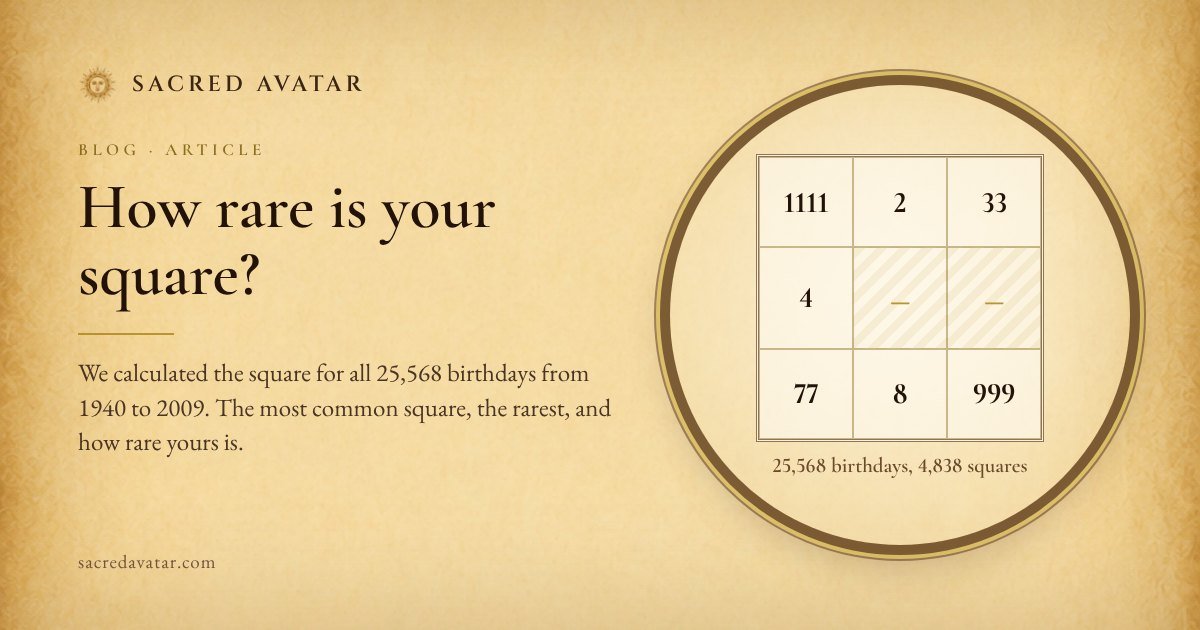
- We calculated the Pythagorean square for every birth date from 1 January 1940 to 31 December 2009: 25,568 dates.
- Those dates produce only 4,838 different squares. A typical square is shared by about 8 other birthdays in those 70 years.
- 3.2% of birthdays have a square that no other date in the period has. A square with all nine cells filled is rarer still for most people: 2.6%, about 1 in 38.
- For people born from 2000 onwards the square changed: 53% of them have an empty 9 cell, which never happens for anyone born from 1940 to 1999.
How we counted
The Pythagorean square, also called the psychomatrix, counts how often each digit from 1 to 9 appears in a date of birth and in four working numbers calculated from it. Zeros are not counted. We used the classical method, exactly as our free Pythagorean square calculator does, and ran it for each of the 25,568 calendar dates from 1940 to 2009, leap days included.
Two people born on the same day always have the same square. The question here is different: how many other birthdays end up with your square, and which squares almost nobody has.
4,838 squares for 25,568 birthdays
Many different dates lead to the same nine counts. On average a square is shared by about 10 dates in our 70-year period, and the typical (median) birthday shares its square with 8 dates in total.
| How many dates share the square | Share of birthdays |
|---|---|
| Only this date (one of a kind) | 3.2% |
| 2 to 5 dates | 25.8% |
| 6 to 10 dates | 29.3% |
| 11 to 20 dates | 31.7% |
| 21 dates or more | 10.0% |
The most common square
The square that appears most often belongs to 36 different birthdays, for example 19 August 1947, 18 September 1947 and 19 July 1948. It has four ones, one two, two threes, one four, two sevens, one eight and three nines, with the 5 and 6 cells empty.
It is common for a simple reason: its dates use the same digits in a different order. Swap the day and the month, or move a digit from the day to the year, and the working numbers often stay the same.
The rarest squares
- All nine cells filled: 668 dates, or 2.6%. The first in our period is 7 May 1940.
- Six or more empty cells: 77 dates, or 0.3%. One of them is 1 January 2000.
- Nine ones in one cell: the record. Only two dates in 70 years have it, 11 November 1941 and 11 November 1961.
- One of a kind: about 820 dates have a square that no other date between 1940 and 2009 shares.
Check how rare your square is
Enter your date in the calculator and count the empty cells. Then find your line:
| Empty cells | Share of birthdays | How rare |
|---|---|---|
| 0 | 2.6% | Rare: about 1 in 38 |
| 1 | 17.9% | Uncommon |
| 2 | 37.4% | The most common result |
| 3 | 28.2% | Common |
| 4 | 10.5% | Uncommon |
| 5 | 3.0% | Rare |
| 6 or more | 0.3% | Very rare: about 1 in 330 |
What each empty cell means in the tradition is explained in our article on empty cells.
Born after 2000: a different square
The year takes up half the digits of a date, so the century changes the square more than anything else. Every year from 1900 to 1999 starts with a 1 and a 9, and every year from 2000 starts with a 2 and a 0.
| Cell | Empty, born 1940–1999 | Empty, born 2000–2009 |
|---|---|---|
| 1 · Character & Will | 0% | 5.3% |
| 2 · Energy | 8.6–13.5% | 0% |
| 9 · Mind & Memory | 0% | 53.3% |
So an empty 9 says nothing about memory as such: more than half of a whole generation has one. This is why the tradition reads every cell together with the rest of the square and never on its own.
Leonardo da Vinci: rarer than 97% of birthdays
Leonardo was born on 15 April 1452. His square has five empty cells: 3, 6, 7, 8 and 9. Among people born from 1940 to 2009, only 3.3% have five or more. His full reading is on our sample page.
What rarity does and does not mean
A rare square is not a better square, and a common one is not a weaker one. Rarity comes from the calendar: which digits a date happens to contain. It is a curiosity, not a verdict, and the square never predicts events.
What matters in a reading is the balance of your own cells and lines. You can see your square free in the calculator. Your full chart of 37 positions starts with the form below.
Questions
How many different Pythagorean squares are there?
Among all 25,568 birth dates from 1940 to 2009 there are 4,838 different squares. A typical square is shared by about 8 birthdays in that period, and 3.2% of dates have a square no other date shares.
How rare is a Pythagorean square with no empty cells?
A square with all nine cells filled occurs for 2.6% of birth dates from 1940 to 2009, about 1 in 38. The most common result is two empty cells, at 37.4%.
Why do people born after 2000 often have an empty 9 cell?
Every year from 1900 to 1999 contains a 9, so for those dates the 9 cell is never empty. Years from 2000 start with 2 and 0, and 53% of dates from 2000 to 2009 have an empty 9 cell.
Does a rare square mean something special?
No. Rarity comes from the digits a date happens to contain. A rare square is not better or worse than a common one, and the square does not predict events.
See your own chart
Enter your date of birth to see your full chart, the Pythagorean square included, with every number calculated — free.
Looking for a holiday gift? Give an Avatar Book: a full reading from their date of birth.
Every text in the reading was written by people, not AI. Read what readers say.
Sources
- Our calculation: the classical psychomatrix method (four working numbers, zeros not counted) applied to every calendar date from 1 January 1940 to 31 December 2009, 25,568 dates. The same method runs in our free calculator. sacredavatar.com
- Alexander Alexandrov, Numerology: A Complete Course. A Self-Study Guide to Digital Analysis (Moscow: AST, 2025), in Russian. Alexandrov is the author of the psychomatrix, the modern form of the Pythagoras square. ast.ru